
EkaivaKriti
AI-Powered Solutions
Building a demo takes a weekend. Building a system takes engineering. Here is why the "Pilot Trap" kills innovation and how to escape it.
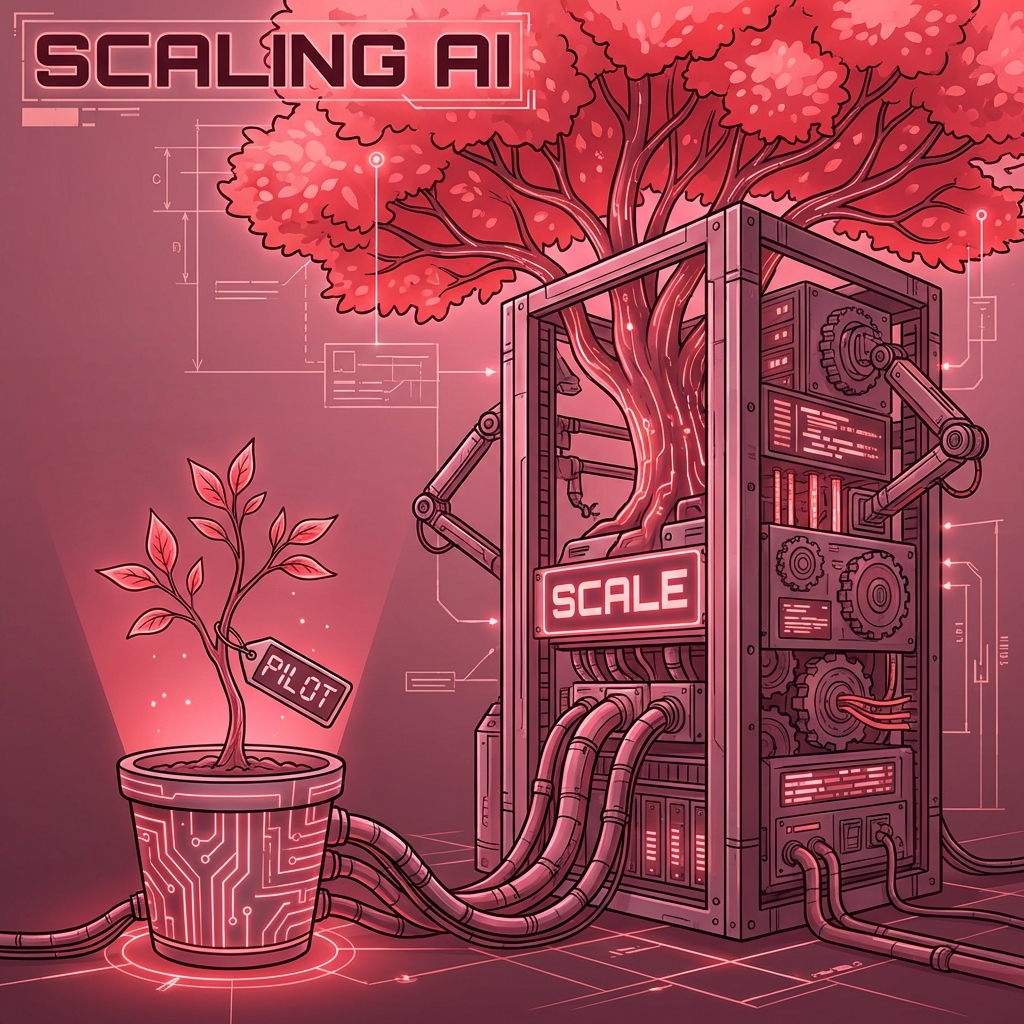
2024 and 2025 were the years of the "Pilot." Every company launched a chatbot trial, a document summarizer, or a marketing generator. But in 2026, many of those projects are sitting in "Pilot Purgatory"—stuck in sandbox mode, used by only a handful of employees. Why?
Most pilots are built with "glue code." A developer connects OpenAI's API to a frontend using LangChain, scans 10 PDF documents, and it works great... for 5 users. But when you try to roll it out to 1,000 employees and connect it to 50,000 documents, the architecture collapses.
The 4 Killers of Scalability:
To move from Pilot to Production, you need to stop thinking about "AI Magic" and start thinking about "Software Engineering."
"Does the AI answer correctly?" shouldn't be a vibe check. You need Regression Testing.
Before deployment, we build a "Golden Dataset" of 500+ Q&A pairs. Every time we update the prompt or model, we run an automated simulation. "Did the accuracy score drop from 95% to 92%?" If yes, the deployment is blocked. This brings DevOps discipline to AI (LLMOps).
Simple vector search isn't enough for enterprise data.
Production systems use Hybrid Search with re-ranking algorithms to get the best of both worlds.
Don't use GPT-4 for everything. It's too slow and expensive.
We build a "Router" layer.
- Simple greeting? → Use a tiny, fast model (GPT-3.5 Turbo or Haiku).
- Complex reasoning? → Use a heavy model (GPT-4o or Claude 3.5 Sonnet).
This drastically reduces latency and cost.
We are engineers first. We build AI with logging, monitoring, rate-limiting, cost-controls, and rigorous testing frameworks. We treat LLMs as just another component in a robust distributed system.
If you are tired of playing in the sandbox and ready to build enterprise-grade infrastructure that survives the real world, we are your partner.
Stuck in "Pilot Purgatory"? Let our engineers review your current setup and give you a technical roadmap to 10x scalability.
Schedule a Scalability Audit